When former President Joe Biden unveiled his US$1.9 trillion infrastructure plan in 2021, he discovered the right place to go public: Philadelphia’s thirtieth Avenue Station rail yard.
Over the din of crackling wires and grumbling engines, the president made his case for revitalizing the nation’s roads, ports, airports and rail traces.
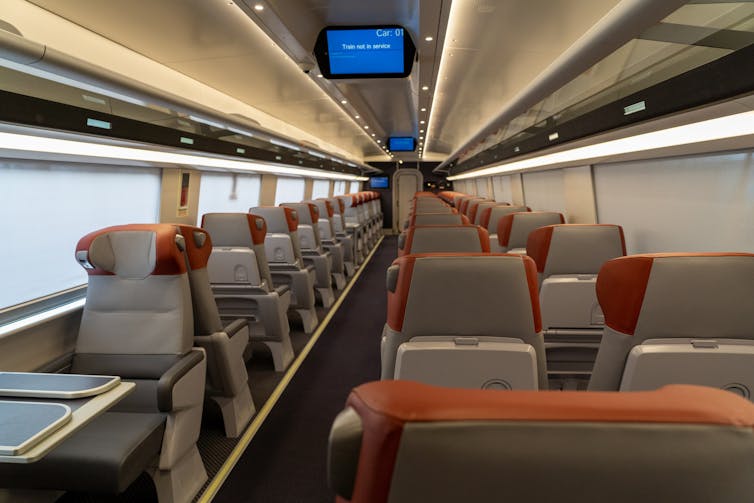
Behind Biden sat rows of gleaming Amtrak trains. Amongst them was a prototype of NextGen Acela, a glossy machine engineered to ship the quickest passenger service in American historical past.
On Aug. 28, 2025, NextGen will finally hit the rails, after years of delays.
Because the writer of a book on the Northeast Corridor, the rail line that connects Boston, New York, Philadelphia and Washington, I do know this new practice can not come quickly sufficient for a lot of seaboard riders, despite the fact that it launches at a time of diminished political will for passenger rail.
Rail renaissance below fireplace
The French-designed, American-manufactured NextGen arrives years late attributable to mechanical defects and failed simulation tests mandated by the Federal Railroad Administration. The brand new Acela will start whisking passengers alongside the hall after a chaotic yr that noticed downed wires, busted circuit breakers and brushfires disrupt Amtrak operations.
Gone is Amtrak’s White Home champion, railfan-in-chief Biden, changed by Donald Trump, whose one-time adviser, Elon Musk, referred to as Amtrak a “sad situation,” and who proposed changing the government-owned provider with personal rivals.
Amtrak CEO Stephen Gardner resigned in March 2025, and, in Could, Amtrak reduce 450 employee positions.
NextGen Acela guarantees an American rail renaissance in a second when federally sponsored trains are combating for his or her lives, as Biden’s infrastructure ambitions fall to an administration bent on chopping authorities prices.
These contradictions, nonetheless, are nothing new.
Not-so-fast trains
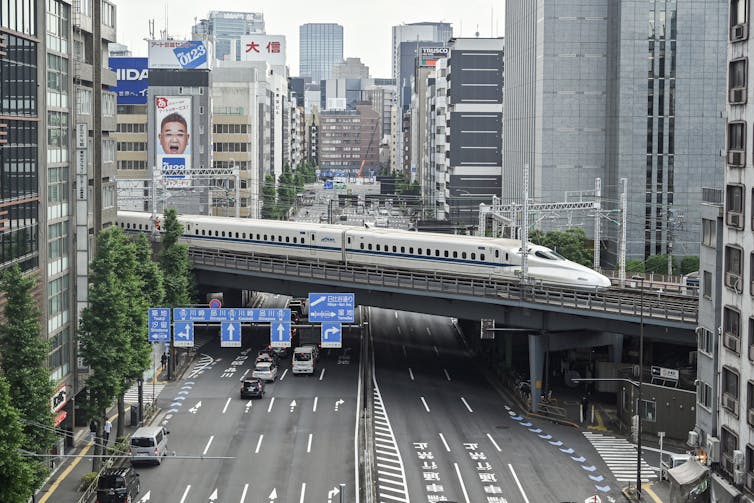
America’s love-hate relationship with quick trains stretches again to October 1964, when Japanese Nationwide Railways opened its Shinkansen high-speed line between Tokyo and Osaka.
Japan’s iconic 130-mph bullet practice entranced audiences, lots of whom noticed footage of the brand new service throughout televised coverage of the Tokyo Olympics.
People needed their very own bullet practice however have been reluctant to pay the large infrastructural prices of a Shinkansen system. When Congress handed the High-Speed Ground Transportation Act of 1965, it prioritized the event of trains over the reconstruction of tracks, energy methods and upkeep services.
The ensuing providers underperformed.
On Dec. 20, 1967, a fuel turbine practice manufactured by United Plane topped 170 mph whereas testing in New Jersey. However when the so-called TurboTrain entered service, it managed a mean tempo of simply 63 mph on the weaving monitor between New York and Boston.
The electric-powered Metroliner, which started service in 1969, boasted related potential however hardly ever held triple-digit speeds in service and broke down so usually that its provider, the Penn Central Railroad, struggled to maintain the trains running between New York and Washington.
Historians often regard these high-speed forays as resounding failures.
However riders cherished them.
Technical flaws apart, each the TurboTrain and Metroliner were a hit with northeastern riders, a lot in order that Amtrak retained the Metroliner model till 2006, lengthy after it had retired the ‘60s-era trains.
Reflecting in 1999, rail journalist Don Phillips expressed disbelief “that these canine have been truly well-liked with the driving public.”
The start of Acela
Amtrak opened a brand new period of high-speed rail in 2000 when it launched Acela Express.
Derived from France’s acclaimed TGV design, Acela carries passengers at speeds as much as 150 mph on the Northeast Hall.
Just like the Metroliner earlier than it, Acela suffered from design issues and mechanical faults, together with cracked yaw dampers and brake discs, which briefly sidelined the trains.
Rail author Joseph Vranich described Acela as each “Amtrak’s crown jewel” and a “remarkable fiasco.”
And but riders flocked to the service. Acela grew to become one in every of Amtrak’s most popular and lucrative trains – so engaging that it lured enterprise vacationers off regional airways.
When Acela entered service in 2000, Amtrak trains claimed simply 37% of air-rail traffic between New York and Washington. By 2021, it had 83%. Between New York and Boston, that determine jumped from 20% to 75%.
Acela 2.0
Now, NextGen Acela takes up the fraught legacy of American high-speed rail. What can we count on of the brand new practice?
NextGen is quicker than the unique Acela however is not going to set any world velocity data. Its high velocity of 160 mph falls wanting international benchmarks set by China’s Fuxing, which hits 217 mph, and Japan’s latest Shinkansens, which attain 200 mph.
With higher tracks and alerts, NextGen may conceivably ramp as much as 186 mph, although such speeds gained’t be attainable anytime quickly.
For now, NextGen will make do with an imperfect hall. The practice’s light-weight design means faster acceleration and lower energy consumption. An enhanced dynamic tilting system will let carriages lean into curves on the hall’s twisting monitor, in order that they lose much less velocity on turns. The unique Acela additionally tilted, however not as a lot.
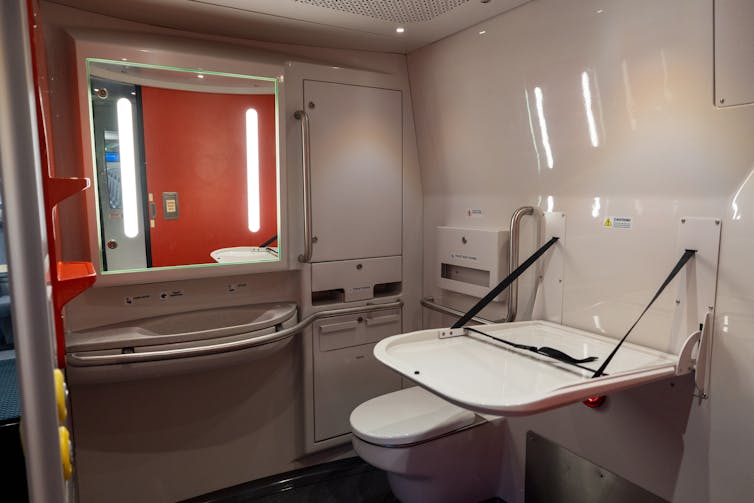
The upgraded onboard experience consists of winged headrests, seat-side USB ports and 5G Wi-Fi. Extra importantly, every NextGen practice can seat 82 more passengers than its predecessor. When Amtrak’s full fleet of 28 NextGens enters service, sending the first-generation trains into retirement, Acela service capability can have increased by 4,728 seats.
This determine often is the practice’s best achievement in a congested area at a time when Amtrak is posting record ridership.
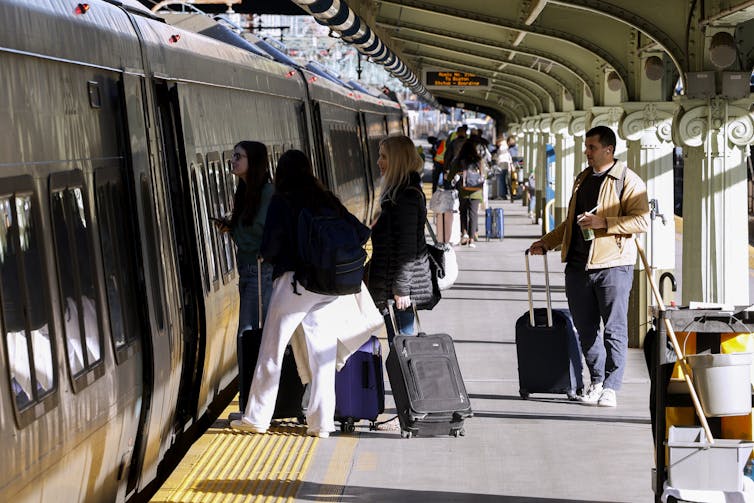
The results of the Northeast’s post-pandemic passenger surge are nowhere extra seen than the Philadelphia rail yard the place Biden spoke 4 years in the past. Amtrak is developing a brand new maintenance shop beside the Schuylkill River that may service NextGen trains and cement Philly’s function within the railroad’s addition of a million annual seats to its non-Acela corridor trains. Powered by typical electrical locomotives, these slower, cheaper “Regionals” accounted for 77% of corridor ridership in 2024 and can proceed to hold the majority of northeastern passengers.
In the meantime, a quarter-mile south of the upkeep store, America’s third-busiest passenger hub, thirtieth Avenue Station, is receiving a generational overhaul with a brand new meals court docket, exterior plaza, outlets and underground entry to speedy transit.
These initiatives exhibit the financial energy of quick, frequent trains in Philly and all through trackside communities of the Northeast. America’s embattled however resilient high-speed rail custom might by no means be the world’s finest, however even incremental enhancements, like NextGen, can not assist however rework the locations they serve.
For Amtrak’s hall area, the stakes have by no means been greater.
Learn extra of our tales about Philadelphia.
David Alff, Affiliate Professor of English, University at Buffalo
Trending Merchandise

Zalman P10 Micro ATX Case, MATX PC ...

ASUS TUF Gaming A15 Gaming Laptop, ...


HP 17.3″ FHD Business Laptop ...
Lenovo IdeaPad 1 Scholar Laptop com...
TP-Hyperlink AXE5400 Tri-Band WiFi ...
NETGEAR Nighthawk WiFi 6 Router (RA...